Poker hand rankings: Texas Hold’em hands from best to worst
A royal flush is the best poker hand and high card the weakest. From best to worst, the ten hands are royal flush, straight flush, four of a kind, full house, flush, straight, three of a kind, two pair, one pair and high card.
Last updated
Maintained by Pokerista Academy. The counts and examples on this page come from running the Academy’s hand evaluator; rules follow the sources below. Independent poker-expert review: pending (how the material is checked).
In Texas Hold’em you make the best five-card hand you can from seven cards: your two hole cards and the five community cards on the board. You can use both hole cards, one or neither. Any hand in a higher category beats every hand in a lower one. Within a category, the tie-break rules below decide, and suits never do.
The ten poker hands, best to worst
Read each example as a complete five-card hand. The line marked “Ties” says how two hands of the same kind are compared.
Royal flush
Ace, king, queen, jack and ten, all of one suit.
Ties: Nothing beats it. Two players can share one only when all five cards are on the board, and then they split the pot.
Strictly, a royal flush is the ace-high straight flush, so some references, including pagat.com and the Academy’s beginner guide, list nine categories. It gets its own row here because it is the one hand that can never lose.
Straight flush
Five cards in sequence, all of one suit.
Ties: The higher top card wins. 5–4–3–2–A of one suit is the lowest straight flush, because its top card is the five.
Four of a kind · also called quads
Four cards of one rank, plus any fifth card.
Ties: The higher four wins. When the four are on the board, the fifth card, the kicker, decides.
Full house · also called a boat
Three cards of one rank and two of another.
Ties: Compare the three first, then the pair: kings full of fours beats fours full of kings.
Flush
Five cards of one suit that are not in sequence.
Ties: Compare the highest card, then the next, down to the fifth. The suit itself never counts.
Straight
Five cards in sequence, of more than one suit.
Ties: The higher top card wins. The lowest straight is 5–4–3–2–A, called the wheel.
Three of a kind · also called a set or trips, depending on how it is made
Three cards of one rank and two unmatched cards.
Ties: The higher three wins, then the higher kicker, then the second kicker.
Made with a pocket pair and one matching board card, it is a set; made with one hole card and a pair on the board, it is trips.
Two pair
Two cards of one rank, two of another and one unmatched card.
Ties: Compare the higher pair, then the lower pair, then the kicker.
One pair
Two cards of one rank and three unmatched cards.
Ties: The higher pair wins, then the kickers, one at a time from the highest.
High card · also called no pair
Five unmatched cards with no straight and no flush.
Ties: Compare the highest card, then the next, down to the fifth.
The gap between categories is absolute. The lowest full house beats the best flush, and the lowest straight beats the best three of a kind:
- Full house, twos full of threes
- Flush, ace high
- Straight, five high
- Three aces
Printable hand rankings chart
The same ten hands on one sheet, with how often each one turns up by the river. Print it or save it to keep beside you while you practise; the list above and the table below give the same information as text.
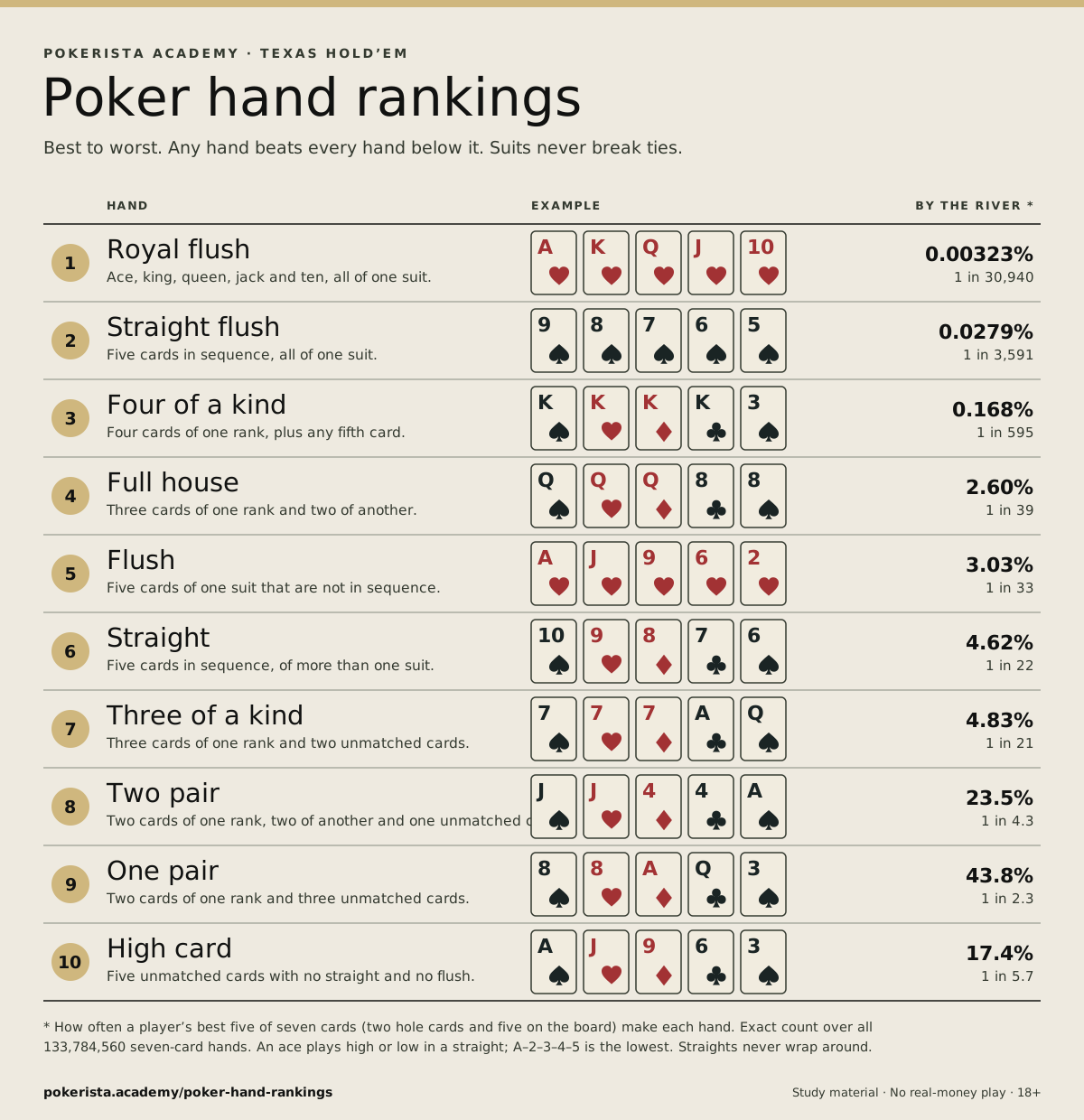
How often does each hand come up?
Rarer hands rank higher. The table counts every possible hand exactly, with no simulation: all 2,598,960 five-card hands, and all 133,784,560 seven-card hands, which is what a Texas Hold’em player holds by the river.
| Hand | By the river (best five of seven) | In five cards | Five-card hands | Distinct hands |
|---|---|---|---|---|
| Royal flush | 0.00323% | 0.000154% | 4 | 1 |
| Straight flush | 0.0279% | 0.00139% | 36 | 9 |
| Four of a kind | 0.168% | 0.0240% | 624 | 156 |
| Full house | 2.60% | 0.144% | 3,744 | 156 |
| Flush | 3.03% | 0.197% | 5,108 | 1,277 |
| Straight | 4.62% | 0.392% | 10,200 | 10 |
| Three of a kind | 4.83% | 2.11% | 54,912 | 858 |
| Two pair | 23.5% | 4.75% | 123,552 | 858 |
| One pair | 43.8% | 42.3% | 1,098,240 | 2,860 |
| High card | 17.4% | 50.1% | 1,302,540 | 1,277 |
| All hands | 100% | 100% | 2,598,960 | 7,462 |
Distinct hands ignore suits. There are 5,108 five-card flushes, not counting straight flushes, but only 1,277 different flush strengths, because the ranks decide between two flushes and the suit never does.
The river column is about one player’s own seven cards: the share of all seven-card combinations whose best five make each hand, if you stay in to see all five board cards. It is not your chance of winning a pot, which depends on everyone else’s cards too.
The ranking follows the five-card columns. With seven cards to choose from, one pair (43.8%) and two pair (23.5%) both turn up more often than high card (17.4%), but the order does not change: a pair still beats high card.
How these numbers were made: every five-card and seven-card hand was scored by the Academy’s own hand evaluator. The counts match an independent combinatorial count and the published tables in Wikipedia’s “Poker probability” article exactly. A random five-card hand is a royal flush 4 times in 2,598,960, or 1 in 649,740.
Does a flush beat a straight?
Yes. A flush beats a straight, and a full house beats both. Leaving out straight flushes, 5,108 of all five-card hands are flushes and 10,200 are straights, so the flush is rarer and ranks higher. By the river, a player’s best five make a flush 3.03% of the time and a straight 4.62%.
- Board
- You
- Best five: flush
- Opponent
- Best five: straight
Your ace-high flush beats the ten-high straight.
Is an ace high or low?
Both, but never in the same hand. An ace is the highest card, so a pair of aces beats a pair of kings, and A–K–Q–J–10, known as Broadway, is the highest straight. In a straight the ace can also play low, in 5–4–3–2–A, called the wheel. The wheel counts as a five-high straight, so every other straight beats it, including 6–5–4–3–2.
Straights never wrap around the ace. Q–K–A–2–3 is not a straight; it is just ace-high. From strongest to weakest:
- Broadway, ace high
- Six-high straight
- The wheel, five high
- No straight: ace-high
What happens when two hands are identical?
The pot is split. Compare the hand category first, then the ranks of the best five cards. Hands tie only when both the category and all five ranks match. Suits never break a tie: in Texas Hold’em no suit outranks another.
- Board
- You
- Best five: straight
- Opponent
- Best five: straight
Both players make the same ace-high straight. The pot is split; the different suits of their aces and tens make no difference.
If a split pot cannot be divided evenly, tournament rules give the odd chip to the tied player seated first to the left of the button, not to a better suit (Poker TDA Rule 20).
Two flushes at the same showdown are always in the same suit. Each player holds only two cards, so every flush needs at least three board cards of its suit, and a five-card board cannot hold three cards of two different suits.
What does “the board plays” mean?
Sometimes the five community cards are the best hand anyone can make. Then every player still in the hand has at least that hand, and the pot is split unless someone improves on it.
- Board
- You
- Best five: straight
- Opponent
- Best five: straight
Neither player’s hole cards improve the nine-high straight on the board, so both play the board and split the pot.
- Board
- Third player
- Best five: straight
Now add a third player holding a ten. They make a ten-high straight and win the whole pot, because both players in the example above are still playing the board.
In a live game, show both hole cards if you are playing the board. Tournament rules require you to table all your hole cards to get any part of the pot, and in hold’em that means both of them (Poker TDA Rules 19 and 13-A). Throwing them away first can cost you your share.
What is a kicker?
A kicker is a card that is not part of your pair, two pair, three of a kind or four of a kind, but still belongs to your best five. When two players have the same pair, the kickers are compared from the highest down. Only five cards ever count, so a sixth or seventh card never breaks a tie.
- Board
- You
- Best five: one pair
- Opponent
- Best five: one pair
Both players have a pair of kings. The first kicker settles it: your queen beats the jack, so you win the pot.
- Board
- You
- Best five: one pair
- Opponent
- Best five: one pair
Both best hands are A–A–K–Q–9: the pair of aces plus the board’s king, queen and nine. The six and the three would be sixth and seventh cards, so neither counts, and the pot is split.
Common misreads
- Four cards of one suit are not a flush. Holding on gives you four hearts, so your hand is only ace-high.
- Three pairs play as two pair. Holding on , your best five are K–K–Q–Q–A. Your fives do not play, and everyone still in the hand has at least the same two pair. The glossary calls this being counterfeited.
- Two three-of-a-kinds make a full house. Holding on , you have kings full of sevens.
- Six cards in a row are still one five-card straight. Holding on , your best straight is nine-high; the four is left out.
- You do not have to use both hole cards. Holding on , your one heart makes an ace-high flush.
- The three decides a full house, not the pair. On , makes kings full of fours and beats , which makes fours full of kings.
- What you announce does not change your hand. Say “two pair” while holding a flush and you still have the flush. Tournament rules let the cards speak for themselves: a verbal declaration is not binding at showdown, and dealers should read and announce each hand (Poker TDA Rule 12). Deliberately miscalling a hand can still be penalised.
Put the rankings to work in free daily practice scenarios, played with imaginary chips.
Keep learning
See where these hands fit in a full hand of Texas Hold’em in the beginner’s guide, including the full rules and starting hands. Look up the kicker in poker, the nuts and playing the board in the glossary. The free course Your first seat at the table covers the rules, hand rankings and language of the game.
Sources & further reading
The explanations are Pokerista Academy teaching material. These references cover the rules and the published probability tables used as a cross-check; they do not endorse Pokerista Academy or certify its exercises.
- Tournament rules, procedures & addendum (2024, Rules 12, 13, 19 and 20) — Poker Tournament Directors Association
- Ranking of poker hands — John McLeod · pagat.com
- Robert’s Rules of Poker (version 11, PDF) — Robert Ciaffone · via pagat.com
- Poker probability (published frequency tables used as a cross-check) — Wikipedia
Put the ideas into practice.
Start with the free introductory courses and save your progress as you learn.
For learning purposes only. Not a gambling app. Guides, not personalized betting advice. No real-money play or guaranteed results. AI can make mistakes. Read the educational disclaimer.